
The ice storm on March 30, 2025, had a significant impact on the urban tree canopy in Barrie and surrounding areas. More than 5,000 street trees and park trees were lost due to damage caused by significant accumulation of ice, resulting in trees and branches falling onto roads, parks and into private property from City-owned lands. As this represents over 10% of the City's street and park tree inventory, the lost trees had a significant detrimental impact on long-term tree canopy goals.
Rapid replanting and care of these trees is required to ensure that future generations can achieve a long-term healthy urban tree canopy. The replacement planting program was approved by Council on June 18, 2025, representing a $2.1M investment in City parks, neighbourhoods, and natural spaces. As well, community partners such as Living Green Barrie are helping to replant trees.
The project includes:
- assessing where and what type of planting will have the greatest short- and long-term benefit for Barrie's urban canopy, and long-term impacts to the urban canopy
- removing stumps
- replanting trees
- watering and management
A normal year of tree removal and replacement is 600 to 800 trees; 5,000 trees represent more than six times the number of trees that die in a single year and are replaced in the normal tree planting program within the City's Operating Budget. Staff have applied for funding support for the replanting program through the Growing Canada’s Community Canopies – Tree Planting grants.
The additional trees will require additional staffing support to manage the annual replanting program, work with affected residents, develop replanting plans for natural area planting in forests heavily impacted by the ice storm, and conduct location-by-location consultation. Additional staffing will result in the replacement of lost trees as quickly and efficiently as possible.
Project Schedule
| Activity | Approx. Date Range |
|---|---|
| Complete City canopy assessment to ascertain total canopy loss as a result of the ice storm | Spring 2025–December 2025 |
| Forest health assessments to determine short- and long-term management needs for heavily affected forested areas | August 2025– September 2026 |
| Stump removal (grinding out) of all destroyed trees | July 2025–August 2026 |
| Replanting of trees on streets, parks and natural areas* | Spring 2026–Spring 2027 (see specific timing) |
| Long term care of damaged trees (monitoring and additional pruning, watering and fertilizing as necessary) | Ongoing |
Stump Removal
Large tree stumps on boulevards and in parks are ground out by a contractor in a two-stage process:
- A large stump grinder unit grinds out the stump and major roots to make room for replanting of a new tree.
- A second crew cleans up the grindings and work area, leaving the site ready for topdressing and seeding or for tree planting. The clean up crew is usually on site within a few hours but may not return until the next day.
When there is sufficient underground space for a new tree, the hole where the stump was ground out is left filled with a mix of soil and wood grindings, which is removed during the tree planting process.
Due to issues with underground utilities (e.g. gas or hydro), there are many cases where the stump cannot be removed to a depth suitable for replanting. In these cases, every effort is made to relocate the new tree on the same boulevard but shifted from the utilities and old stump location. If no alternative planting location is possible, staff will discuss options with the homeowner, which may include replanting the location in a future year after the roots have sufficiently decayed or a non-standard replanting location (e.g. offset on the boulevard).
Tree Planting Timing & Locations
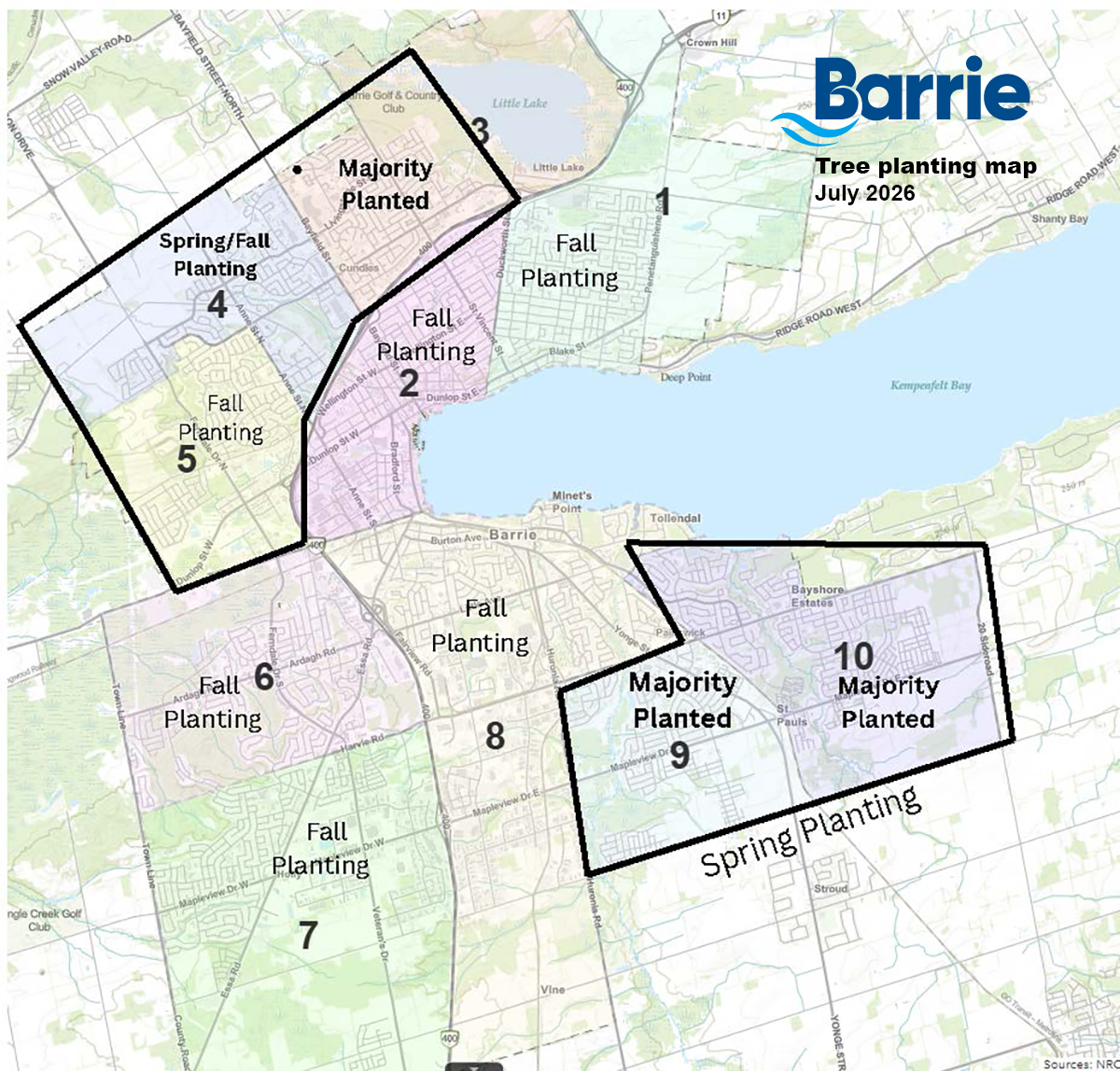
Boulevard inspections and curb marking began in late 2025 to prepare for 2026 planting. Tree planting timing depends on the stump removal process; utility locate clearances and the tree planting seasons. Tree planting only occurs in the spring and fall. Two contractors have been awarded the tree planting work: Drysdale Tree Farms and Lomco. If your location was on the spring 2026 list, but was not yet planted, it was moved to the fall planting program due to timing and delays. If your location is not included on any of the planting lists below, it will be planted through the City's annual tree planting program, completed by Drysdale Tree Farms.
If you do not wish to receive a tree on your boulevard, please contact Service Barrie at ServiceBarrie@barrie.ca to request that no tree be planted.
As of mid July 2026, approximately 1,400 trees lost in the ice storm have been replanted on streets and in parks.
Tree Species
In October 2025, preliminary decisions on street tree species selection were made. Resident requests for tree species were taken into consideration and species adjusted based on all requests that could be accommodated.
Tree species are selected for replanting based on best long-term value and resilience to a number of factors. Staff have an analysis of the percentage of trees impacted by the ice storm by ward and species, and consider species' success prior to selecting tree species at locations. Many factors are considered, including:
- available space (overhead and soil volume)
- soil conditions
- utilities
- setbacks from municipal infrastructure (intersections, signs, signals, street lights);
- species diversity targets set in the Urban Forest Strategy
- resilience to several factors (including drought, salt tolerance, pest susceptibility, compact soil/tight soil conditions, and effect of wind and ice loading on branch structures)
You can contact Service Barrie at 705-726-4242 or ServiceBarrie@barrie.ca to request a specific species, or comment on location or other concerns related to the tree replanting on the boulevard in front of your home. Forestry staff will do their best to accommodate requests, however species selection is based on the limiting factors described above.
View the summary of the tree species used for municipal tree planting in Barrie’s climate zone.